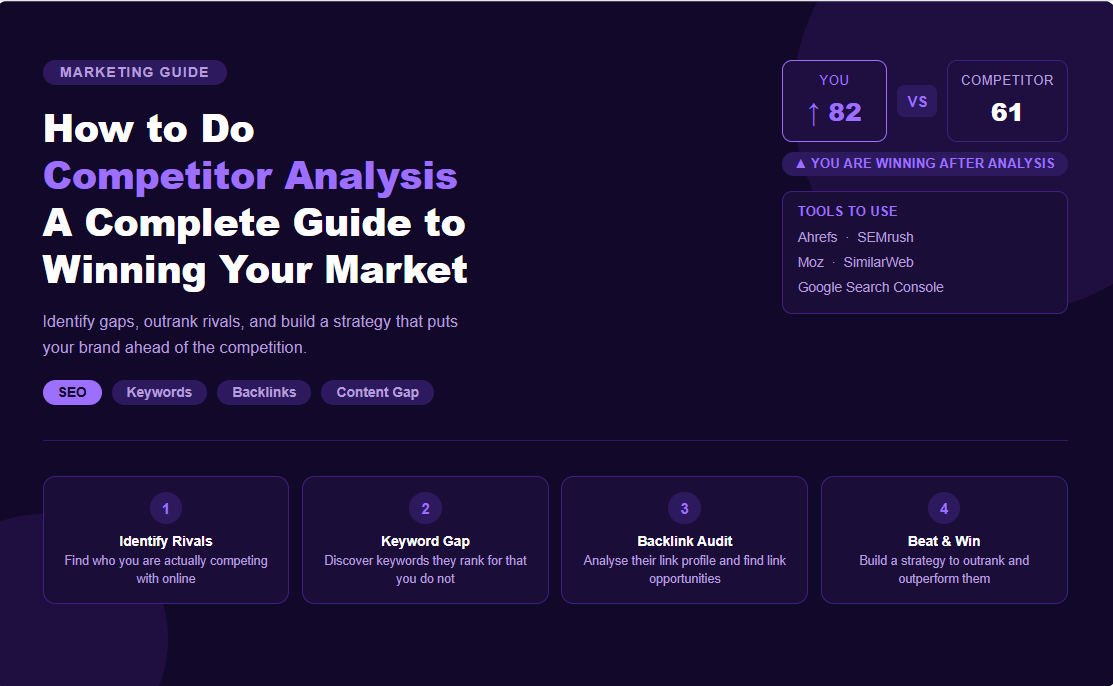
Introduction: Why Competitor Analysis Is Your Business’s Secret Weapon
In today’s hyper-competitive business landscape, understanding your competition isn’t optional—it’s survival. Every day, businesses launch new products, pivot their strategies, and find innovative ways to capture market share. Without a clear view of what your competitors are doing, you’re essentially navigating with a blindfold on, hoping you’ll stumble upon success.
Competitor analysis is the systematic process of identifying, researching, and evaluating your business rivals to understand their strategies, strengths, weaknesses, and market position. It’s not about copying what others do; it’s about understanding the entire playing field so you can make smarter, more informed decisions that give you a competitive edge.
The numbers speak for themselves. The global competitor analysis market has experienced explosive growth, jumping from $4,316.55 million in 2021 to a projected $6,600.18 million by 2025. This remarkable growth demonstrates just how seriously modern businesses take competitive intelligence. Companies that consistently analyze their competition are better positioned to anticipate market shifts, identify opportunities, and avoid strategic missteps that could cost them dearly.
In this comprehensive guide, we’ll walk you through everything you need to know about analyzing competitors effectively—from identifying who you’re really up against, to gathering actionable intelligence, to turning those insights into winning strategies.
Understanding the Three Core Pillars of Competitor Analysis
Before diving into the tactical details, it’s essential to understand that effective competitor analysis rests on three fundamental pillars:
1. Identification: Figuring out who your direct, indirect, and aspirational competitors actually are. This goes far beyond the obvious rivals you see every day.
2. Investigation: Digging deep into their marketing tactics, product offerings, pricing strategies, customer experience, and digital presence to understand how they operate.
3. Implementation: Using structured frameworks like SWOT analysis, keyword gap analysis, and feature matrices to transform raw data into actionable strategic insights.
These three pillars work together to create a comprehensive understanding of your competitive landscape. Skip one, and your analysis will have significant blind spots that could leave you vulnerable to unexpected threats or cause you to miss golden opportunities.
Why Competitor Analysis Matters More Than Ever
Spotting Opportunities Before Your Rivals Do
The primary value of competitor analysis lies in its ability to illuminate hidden opportunities and potential threats before they impact your bottom line. Without regular competitive intelligence, you could completely miss a growing customer segment that a competitor is quietly dominating, or fail to notice a critical weakness in their product that your team could easily address.
When you maintain a proactive approach to competitive analysis, you’re not just reacting to market changes—you’re anticipating them. This forward-thinking mindset is what separates market leaders from followers. You become the company setting industry trends rather than scrambling to catch up.
Fueling Every Aspect of Your Business Strategy
A sharp, well-executed competitor analysis doesn’t just sit in a presentation deck. It actively informs and enhances multiple aspects of your business:
Product Development: Your analysis reveals feature gaps and customer pain points that your product can solve better than existing solutions. By understanding what customers love and hate about competing products, you can build something genuinely superior.
Marketing Strategy: Competitive intelligence shows you which channels your rivals dominate and, more importantly, where untapped audiences exist that they’re completely ignoring. This allows you to allocate marketing resources where they’ll have the greatest impact.
Sales Enablement: Armed with detailed competitive knowledge, your sales team can handle objections confidently and articulate your unique value proposition with precision. They’ll know exactly how to position your solution against any alternative a prospect might be considering.
Pricing Optimization: Understanding how competitors price their offerings—and how customers perceive that value—helps you position your pricing strategically rather than arbitrarily.
The Cost of Ignoring Your Competition
Businesses that neglect competitor analysis often find themselves blindsided by market disruptions. They invest heavily in features customers don’t care about. They miss emerging trends until it’s too late. They watch helplessly as nimbler competitors capture the audiences they thought were theirs.
The reality is stark: in today’s fast-moving markets, ignorance isn’t bliss—it’s a liability. The companies thriving today are those that have made competitive intelligence a core component of their strategic planning, not an afterthought.
Identifying Your True Competition: Beyond the Obvious
One of the biggest mistakes businesses make is having tunnel vision about their competition. They only watch the rivals that look and sound just like them, creating dangerous blind spots that leave them vulnerable to threats they never saw coming.
Your competitive landscape is actually a layered ecosystem with different types of players, each presenting unique challenges and requiring different strategic responses.
The Three Tiers of Competition
Direct Competitors: These are the straightforward rivals—companies offering nearly identical products or services to the same target audience, solving the same core problem. If you’re building a project management SaaS platform, your direct competitors are established players like Asana, Trello, Monday.com, and ClickUp. These companies are competing for the exact same dollars from the same customers, and they’re probably top-of-mind whenever a prospect is evaluating solutions.
Indirect Competitors: This is where analysis gets more nuanced and interesting. Indirect competitors solve the same fundamental problem for your customers but use a completely different approach or solution. They’re satisfying the same need, just through an alternative method.
For that project management SaaS example, indirect competitors might include:
- Spreadsheet Software: Excel and Google Sheets remain powerful indirect competitors. Never underestimate how many teams still manage complex projects using nothing but shared spreadsheets.
- Communication Platforms: Teams that coordinate exclusively through Slack channels and shared Google Docs are essentially managing projects without dedicated project management software.
- Note-Taking Apps: Flexible platforms like Notion, Evernote, or Coda can be adapted into project tracking systems, pulling potential customers away from specialized solutions.
The danger of ignoring indirect competitors is that you’re missing a massive part of the customer decision-making process. You’re not just competing against other SaaS products; you’re competing against ingrained workflows and “good enough” solutions that require no additional investment.
Aspirational Competitors: These are the market leaders and industry giants that set the standard in your space or adjacent markets. They might not be your direct competition today, but they represent who your customers secretly compare you to. They also serve as a masterclass in exceptional strategy and execution.
For a growing SaaS company, aspirational competitors might include brands like HubSpot (renowned for content marketing excellence), Slack (famous for seamless user onboarding), or Salesforce (the gold standard for enterprise sales processes). Studying these industry leaders helps you set a much higher bar for your own work and identify best practices worth emulating.
Mapping Your Complete Competitive Landscape
Creating a comprehensive map of all three tiers gives you a complete, 360-degree view of the forces shaping your market. This ensures your analysis is rooted in reality, not just a narrow slice of it.
Start by listing out 5-10 companies in each category. For each competitor, note:
- Their primary value proposition
- Target customer segment
- Core strengths and known weaknesses
- Recent strategic moves (funding, acquisitions, product launches)
- Market positioning and brand perception
This exercise alone will reveal competitive dynamics you likely haven’t considered. You might discover that your biggest threat isn’t another startup—it’s the free tools customers are already comfortable using.
The Core Components of Modern Competitor Analysis
Once you know who you’re analyzing, the next step is understanding what to analyze. A comprehensive competitor analysis in today’s market should cover several critical areas:
1. Marketing and Sales Strategy
Understanding how competitors attract and convert customers is fundamental. This includes:
Marketing Channels: Which platforms do they prioritize? Are they heavy on content marketing, paid advertising, influencer partnerships, or email campaigns? Where do they invest most heavily?
Messaging and Positioning: How do they talk about themselves? What pain points do they emphasize? What language and terminology do they use?
Content Strategy: What type of content do they produce? Blog posts, videos, podcasts, webinars? How frequently do they publish, and what topics get the most engagement?
Sales Funnel: How do they move prospects from awareness to purchase? What does their lead magnet look like? What’s their onboarding sequence?
Analyzing these elements reveals not just what they’re doing, but where they’re finding success—and where they might be struggling.
2. Product Features and User Experience
Your competitors’ products tell a story about what the market values and where gaps exist.
Core Offerings: What are their flagship products or services? What problems do these solutions solve?
Unique Features: What capabilities do they offer that differentiate them? Are these features truly valuable, or just marketing fluff?
User Interface and Experience: Is their product intuitive and user-friendly, or cluttered and confusing? How does the onboarding experience compare to yours?
Product Roadmap: What have they announced for future releases? This gives you insight into their strategic direction.
Customer Reviews: What do real users love and hate? Review sites like G2, Capterra, and Trustpilot are goldmines for understanding actual customer sentiment.
3. Pricing and Value Proposition
Pricing strategies reveal volumes about positioning and target markets.
Pricing Models: Do they use subscription-based pricing, one-time purchases, freemium models, or usage-based billing?
Price Points: How do their prices compare to yours and other competitors? Are they positioning as a premium solution or competing on affordability?
Discounts and Promotions: Do they run frequent sales? Offer annual discounts? Have special pricing for specific industries or company sizes?
Perceived Value: How do customers perceive the value relative to cost? Are they seen as overpriced or a great deal?
4. Customer Experience and Support
How competitors treat customers throughout the entire lifecycle often determines long-term success.
Onboarding Process: How smooth and comprehensive is their new customer experience?
Support Channels: Do they offer live chat, phone support, email tickets? What are their response times?
Community Engagement: Do they maintain active user communities, forums, or social media groups?
Brand Voice: Is their communication formal and corporate, or casual and friendly?
5. Digital Presence and SEO Performance
In today’s digital-first world, online visibility is critical.
Website Traffic: How many visitors do they attract monthly? What are the traffic trends?
Top Keywords: Which search terms are they ranking for? Where are they dominating, and where are they weak?
Backlink Profile: Who’s linking to them? The quality and quantity of backlinks indicate authority and reach.
SERP Rankings: For key industry terms, where do they appear in search results compared to you?
Building Your Intelligence Gathering Toolkit
Manual competitor research—copying and pasting data into spreadsheets—is a reactive approach that ensures you’ll always be playing catch-up. Modern competitor analysis requires building an automated intelligence system that feeds you real-time insights.
Essential Categories of Competitive Intelligence Tools
To build a comprehensive view, you need tools that cover several specialized areas:
SEO and Keyword Research Tools: These platforms reveal which keywords competitors rank for, where their backlinks originate, and how their pages are optimized. This intelligence forms the blueprint of their organic customer acquisition strategy.
Content and Social Media Analytics: These tools show which content resonates with audiences, what gets shared extensively, and how social engagement translates to brand awareness.
Website Traffic and User Behavior Platforms: Understanding traffic sources—organic search, paid ads, social media, direct visits, referrals—provides a high-level view of their digital marketing effectiveness.
Pricing Intelligence Software: Especially critical for e-commerce, these tools track competitor pricing changes in real-time, allowing you to stay competitive.
Social Listening Platforms: These go beyond tracking mentions to analyze sentiment, helping you understand how audiences feel about competitor brands.
The Heavy Hitters: Essential Tools for Deep Analysis
Let’s explore the platforms that marketing and strategy professionals rely on for actionable competitive intelligence:
Semrush for SEO and PPC Intelligence: Semrush is arguably the most comprehensive platform for understanding a competitor’s search engine strategy. You can instantly discover their top-performing organic keywords, analyze their backlink profile to find link-building opportunities, and even peek at their paid advertising campaigns. When you notice a competitor suddenly investing heavily in a new cluster of keywords, that’s a strong signal they’re launching a new product or targeting a new customer segment.
Ahrefs for Backlink Analysis: While similar to Semrush, Ahrefs excels particularly at backlink analysis and site audits. Their “Site Explorer” feature provides incredibly detailed insights into a competitor’s most valuable pages and the referring domains that drive their authority.
BuzzSumo for Content Performance: Wondering which articles, videos, or infographics are generating buzz for your competitors? BuzzSumo shows you the most-shared content across all major social networks. This is invaluable for identifying trending topics and content formats that resonate in your niche, saving you from creating content that nobody wants to read.
Similarweb for Traffic Analysis: Similarweb provides the crucial bird’s-eye view of competitor website traffic. It breaks down visitor sources (search, social, direct, referral, paid), geographic distribution, audience interests, and even which other websites their visitors frequent. This information is priceless for understanding market reach and spotting partnership opportunities.
SpyFu for Competitor Ad Campaigns: SpyFu specializes in uncovering competitor PPC strategies. You can see every keyword they’ve bought on Google Ads, every ad variation they’ve tested, and their estimated ad spend. This is like having access to their entire paid advertising playbook.
Hootsuite or Sprout Social for Social Media Monitoring: These platforms help you track competitor social media activity across multiple platforms, monitor engagement rates, and analyze which content types perform best.
The AI and Automation Revolution
Artificial intelligence is transforming competitive intelligence from a backward-looking report into a forward-looking prediction engine. The global AI market is projected to grow by 38% in 2025, fueling a new generation of tools that don’t just tell you what happened—they forecast what might happen next.
AI-powered platforms use machine learning to identify subtle patterns in pricing fluctuations, detect early signals of marketing campaign launches, and spot changes in content velocity that human analysts would likely miss. These tools can monitor hundreds of competitors simultaneously, alerting you only when significant changes occur that warrant attention.
Budget-Friendly Alternatives
Don’t have thousands to spend on premium tools? You can still gather powerful competitive insights using free or low-cost resources:
Google Alerts: Set up alerts for competitor brand names, key executives, and important industry terms. You’ll receive email notifications whenever they’re mentioned online.
Free Tool Versions: Platforms like Similarweb, Ubersuggest, and Moz offer limited free versions that provide basic traffic and keyword data.
Social Media Following: Simply follow competitors on LinkedIn, Twitter, Instagram, and Facebook. Subscribe to their newsletters. This gives you a front-row seat to their marketing messages.
Review Site Research: Sites like G2, Capterra, Trustpilot, and even Google Reviews contain treasure troves of information about competitor strengths and weaknesses—all completely free to access.
The quality of your analysis isn’t determined by your budget. It’s determined by your consistency and commitment to asking the right questions.
Choosing the Right Framework to Transform Data Into Strategy
Gathering data is just the beginning. Without a structured framework to organize and analyze that information, you’re left with a mountain of facts but no clear path forward.
Analysis frameworks give your data structure, transforming raw information into strategic maps that actually guide decision-making. While SWOT analysis is a solid starting point, let’s explore several frameworks that provide deeper, more actionable insights.
SWOT Analysis: The Classic Foundation
SWOT (Strengths, Weaknesses, Opportunities, Threats) remains popular because it’s straightforward and comprehensive. For each competitor, you identify:
Strengths: What do they do exceptionally well? Where are they clearly superior?
Weaknesses: Where do they struggle? What do customers consistently complain about?
Opportunities: What market opportunities are they positioned to capitalize on?
Threats: What external factors could undermine their success?
While SWOT provides a useful high-level overview, it often lacks the specificity needed for tactical decisions. That’s where more specialized frameworks come in.
Keyword Gap Analysis: Uncovering SEO Opportunities
One of the fastest ways to find strategic openings is examining your competitors’ search engine presence. A keyword gap analysis reveals exactly which valuable keywords your rivals rank for that you’re completely missing.
This isn’t just about collecting keywords—it’s about reverse-engineering their content strategy and understanding their target audiences.
The Process:
- Use an SEO tool like Ahrefs or Semrush to enter your domain and 2-3 top competitors
- Run a keyword gap analysis
- Review the list of keywords competitors rank for that you don’t
- Prioritize based on search volume, difficulty, and relevance
- Create content targeting these gaps
For example, if you sell sustainable coffee and discover a competitor ranks #1 for “best organic coffee for cold brew”—a term you never considered—that single insight reveals a specific, high-intent audience you’re leaving on the table.
Feature Matrix: Benchmarking Your Product
It’s dangerously easy to develop tunnel vision about your own product. A feature matrix forces an objective, side-by-side comparison of capabilities.
How to Build One:
- List your key features down the first column
- Add your main competitors across the top row
- Mark which features each competitor offers
- Include pricing for context
This visual breakdown immediately highlights three critical insights:
Feature Gaps: What do competitors offer that you don’t? More importantly, do customers actually care?
Unique Selling Points: What capabilities can only you provide? This becomes pure marketing gold.
Table Stakes: Which features are now expected as standard in your industry? If you’re missing these, you’re already behind before the sales conversation even starts.
Positioning Map: Visualizing Market Perception
How do customers actually perceive your brand compared to competitors? A positioning map (also called a perceptual map) visualizes this by plotting brands on a two-axis graph, where each axis represents a key attribute customers value.
Creating a Positioning Map:
- Choose two attributes customers care about (e.g., Price vs. Quality, Simple vs. Feature-Rich)
- Place competitors on the map based on customer perception
- Identify crowded areas and empty spaces
- Look for “blue ocean” opportunities where competition is minimal
For instance, if you’re a car manufacturer, you might use “Price” and “Performance” as your axes. If everyone clusters in the “affordable, moderate performance” corner, you might find opportunity in the “premium, high performance” space that’s underserved.
This framework shifts focus from what competitors do to what they represent in customers’ minds, helping you find positioning that stands out.
Competitive Frameworks Comparison
| Framework | Best For | Key Outcome |
|---|---|---|
| SWOT Analysis | Overall strategic position | High-level view of internal capabilities and external market forces |
| Keyword Gap Analysis | SEO and content strategy | Prioritized list of high-value keywords to target |
| Feature Matrix | Product comparison | Clear identification of USPs and development priorities |
| Positioning Map | Brand perception | Insight into market gaps and differentiation opportunities |
| Porter’s Five Forces | Industry structure | Understanding competitive intensity and profitability drivers |
Each framework offers a different lens for viewing the competitive landscape. The most effective analyses use multiple frameworks to build a complete picture.
Turning Competitive Intelligence Into Winning Strategies
All the data collection and analysis in the world is worthless if it just sits in a document. The real value of competitor analysis emerges when you bridge the gap between insight and action—transforming observations into strategies that drive tangible business results.
Informing Product Development
Your competitive analysis should directly influence your product roadmap. The feature matrix and customer review analysis have likely revealed clear market gaps—capabilities customers want that nobody is offering well, or common frustrations with existing solutions.
Action Steps:
- Prioritize Feature Gaps: If multiple competitors lack a feature that customers consistently request in reviews, elevate it in your development queue
- Solve Competitor Weaknesses: If analysis shows a rival’s product is powerful but has terrible UX, make ease-of-use your core differentiator
- Validate Your Roadmap: Use competitive data to confirm planned features will actually provide an advantage when launched
For example, if you run a social media scheduling tool and discover competitors are weak on analytics and reporting, enhancing your own reporting capabilities becomes a clear path to winning dissatisfied customers from those platforms.
Reshaping Marketing and Messaging
Your analysis of competitor messaging and positioning is marketing gold. You now understand how rivals communicate, who they target, and—most valuably—what they’re not saying. This creates your opportunity to own a unique narrative.
Strategic Positioning:
- If everyone competes on price, build your brand around premium quality and superior support
- If their messaging is technical and jargon-heavy, win by being the simple, user-friendly alternative
- If they focus exclusively on features, differentiate by emphasizing outcomes and transformation
The goal isn’t to shout louder—it’s to find the one conversation your competitors aren’t having with customers and make it uniquely yours.
The competitive intelligence software market for small and medium-sized businesses is expected to surge from $2.56 billion in 2023 to $6.02 billion by 2030, demonstrating how companies are moving beyond basic analysis to embed competitive insights into daily operations.
Empowering Your Sales Team
Your sales team needs ammunition to win deals. Comprehensive competitor analysis provides the perfect foundation for creating sales battle cards—concise documents that arm your reps with everything they need to handle competitive situations.
Effective Battle Cards Include:
- Competitor Strengths: What they do well (acknowledge it respectfully, then pivot)
- Competitor Weaknesses: Known product limitations, poor support ratings, or inflexible pricing
- Your Differentiators: The top 3 reasons your solution is superior, in customer language
- “Landmine” Questions: Smart questions that expose competitor weaknesses (e.g., “How customizable is their reporting?” when you know they have limited options)
When salespeople know exactly how to position your product against alternatives, their confidence and close rates both increase dramatically.
Optimizing Pricing Strategy
How competitors price their offerings tells a story about their target markets and perceived value. Analyzing their pricing tiers, discount strategies, and business models can reveal strategic opportunities.
Pricing Insights:
- Is there an underserved market for a more affordable entry-level option?
- Could a premium enterprise tier capture high-value customers that competitors ignore?
- Are competitors’ pricing changes signaling market shifts you should prepare for?
The goal isn’t just competitive pricing—it’s strategic pricing that captures the specific segments you want to serve.
Measuring Success and Iterating
Finally, establish clear metrics to measure whether your competitive strategies are working:
- Market Share Changes: Are you gaining ground against key competitors?
- Win/Loss Analysis: When prospects choose competitors, why? When they choose you, what was the deciding factor?
- Traffic and Rankings: Are you capturing keywords and audiences previously dominated by rivals?
- Customer Feedback: Are customers comparing you more favorably to alternatives?
Competitor analysis isn’t a one-time project—it’s an ongoing process of monitoring, learning, and adapting.
Common Questions About Competitor Analysis
How Often Should I Analyze Competitors?
Competitor analysis isn’t a “set it and forget it” activity. The frequency depends on your industry’s pace:
For Fast-Moving Industries (SaaS, e-commerce, tech): Conduct thorough deep-dives quarterly, supplemented by continuous real-time monitoring of major events like product launches, pricing changes, or significant marketing campaigns.
For Slower-Moving Industries (manufacturing, professional services): Semi-annual comprehensive analyses may suffice, with monthly check-ins on key competitors.
The key is establishing a rhythm of deep analysis paired with automated alerts for significant changes. This hybrid approach keeps you agile without drowning in data.
What Metrics Matter Most?
It’s easy to drown in data. Focus on metrics directly tied to your business objectives:
Marketing & SEO: Top organic keywords, high-authority backlinks, social engagement rates, estimated ad spend
Website Performance: Monthly traffic, top referral sources, average session duration Product: Major feature releases, pricing changes, customer review sentiment Brand: Online mentions, press coverage, Net Promoter Score trends
Choose the 3-5 metrics most critical to your current goals. That focused dashboard turns data overload into actionable intelligence.
Can I Do This Without a Big Budget?
Absolutely. You don’t need expensive software to gather powerful insights. The secret is being systematic and consistent with free resources:
Zero-Cost Tactics:
- Set up Google Alerts for competitor brand names and key executives
- Subscribe to competitor newsletters and follow their social accounts
- Read customer reviews on G2, Capterra, and Trustpilot
- Use free versions of tools like Similarweb, Ubersuggest, or AnswerThePublic
- Manually browse competitor websites and content
Budget doesn’t determine quality—consistency and curiosity do.
Conclusion: Making Competitor Analysis Your Competitive Advantage
Competitor analysis isn’t about paranoia or imitation. It’s about understanding the full context in which your business operates so you can make informed, strategic decisions that position you for long-term success.
The businesses that thrive aren’t necessarily the ones with the best products or the biggest budgets. They’re the ones that understand their competitive landscape deeply, spot opportunities early, and adapt quickly to market changes.
By implementing the strategies and frameworks outlined in this guide—identifying all tiers of competition, building an intelligence toolkit, applying analytical frameworks, and translating insights into action—you transform competitor analysis from a periodic report into a continuous competitive advantage.
Start small if you need to. Pick your top three competitors. Choose one framework. Set up a few alerts. The important thing is to start building the habit of competitive intelligence into your strategic rhythm.
The market won’t wait for you to catch up. Your competitors certainly won’t. But with a systematic approach to competitor analysis, you’ll be the one setting the pace, not struggling to keep up.
Find Guest Posting Websites
Remember: the goal isn’t to become your competitor. It’s to become impossible for them to compete with.