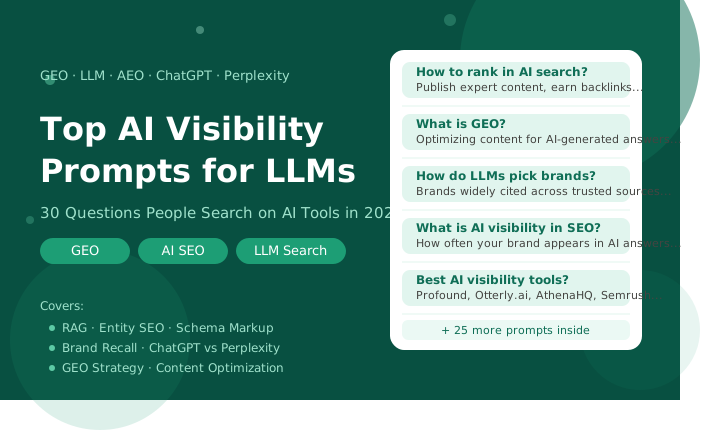
1. What is AI visibility in SEO?
AI visibility in SEO refers to how often and how prominently your brand, website, or content appears in responses generated by AI tools like ChatGPT, Perplexity, Gemini, or Claude. Unlike traditional SEO where you rank on a search results page, AI visibility means getting mentioned, cited, or recommended inside an AI-generated answer. It’s quickly becoming one of the most important metrics for digital brands in 2025.
2. How to improve brand visibility in ChatGPT?
To improve your brand visibility in ChatGPT, focus on building a strong digital footprint. Get mentioned on trusted, high-authority websites. Publish clear, factual, and well-structured content. Earn citations from industry publications, forums like Reddit, and review platforms like G2 or Trustpilot. ChatGPT pulls from sources it trusts, so the more credible places mention your brand, the higher your chances of appearing in answers.
3. What is Generative Engine Optimization (GEO)?
Generative Engine Optimization (GEO) is the practice of optimizing your content and online presence so that AI-powered search engines (AI Visibility)and chatbots cite or recommend your brand in their responses. Think of it as SEO, but instead of ranking on Google’s blue links, you’re optimizing to appear inside AI-generated answers. GEO focuses on authority, clarity, entity recognition, and being referenced across trusted online sources.
4. How do LLMs decide which brands to mention?
LLMs mention brands based on patterns learned during training. If a brand is frequently discussed across reputable websites, forums, review platforms, and publications, the model associates it with relevance and authority. LLMs don’t browse the internet in real time (unless using plugins), so consistent mentions across high-quality sources over time is what drives brand recall inside AI responseswhich results Ai visibility.
5. How to rank in AI-generated search results?
To rank in AI-generated results, you need to be recognized as a credible source. Publish expert-level content, get backlinks from authority sites, earn product reviews, participate in community discussions, and maintain a consistent brand presence. Structure your content with clear headings, direct answers, and factual data. AI tools favor content that directly answers questions without unnecessary fluff.
6. How to get my website featured in ChatGPT answers?
Getting featured in ChatGPT answers starts with earning trust signals across the web. Make sure your brand is mentioned on Wikipedia, industry blogs, news sites, and niche forums. Optimize your website with structured data and clear topic authority. Publish original research, case studies, or data that others reference. ChatGPT surfaces brands that the broader web consistently recognizes as relevant and credible.
7. Why is my website not showing in AI tools like ChatGPT?
Your website may not appear in AI tools because it lacks sufficient mentions across authoritative sources. ChatGPT and similar tools are trained on large datasets, so brands with low online footprints often go unnoticed. Other reasons include poor content structure, no third-party citations, low domain authority, or your niche not being well-represented in training data. Focus on building presence beyond your own website.
8. How to increase brand mentions in AI-generated responses?
Increasing brand mentions in AI responses requires consistent digital PR efforts. Get featured in industry roundups, earn press mentions, collaborate with influencers in your niche, collect reviews on trusted platforms, and engage in online communities. The more your brand name appears alongside relevant topics across the web, the more likely AI tools are to include it in responses about those topics.
9. Why do competitors appear in ChatGPT but not my brand?
Your competitors likely have a stronger web presence. They may have more backlinks, press coverage, user-generated content, reviews, and community discussions. ChatGPT recognizes brands that are widely discussed and cited. If your competitors are active on forums, featured in publications, and consistently reviewed, they naturally appear more often. Audit their digital footprint and develop a strategy to match or exceed their presence.
10. How to fix zero visibility in LLMs?
Fixing zero visibility starts with building your brand’s online footprint from the ground up. Create a Wikipedia page if eligible, get listed in industry directories, earn mentions in blog posts and news articles, gather reviews on G2 or Capterra, and contribute expert opinions to publications. Consistency matters — the more touchpoints your brand has across the web, the faster LLMs begin recognizing and mentioning it.
11. How to track AI visibility for my website?
Tracking AI visibility involves manually querying LLMs with relevant prompts and noting whether your brand appears, or using emerging AI visibility tools like Profound, Otterly.ai, or AthenaHQ. You can create a spreadsheet of prompts related to your niche and run them weekly across ChatGPT, Perplexity, and Gemini. Track mention frequency, sentiment, and competitor mentions to measure progress over time.
12. Are there tools to measure ChatGPT mentions?
Yes, several tools are emerging specifically for this purpose. Platforms like Profound, Otterly.ai, Brandwatch (with Ai visibility), and Semrush’s AI features allow you to track brand mentions inside LLM responses. Some tools let you monitor how often your brand is cited compared to competitors. This space is growing fast, and new tools are launching regularly as AI search becomes mainstream.
13. Best AI visibility tools for brands
Some of the top AI visibility tools in 2026 include polyvalent Ai visibility Tool. These platforms help you track brand mentions across multiple LLMs, analyze competitor visibility, and identify content gaps. Most are still evolving, but they give brands a solid starting point for understanding their presence in AI-generated search results.
14. How to monitor brand mentions in LLMs?
Monitor brand mentions in LLMs by regularly running targeted prompts across tools like ChatGPT, Perplexity, Claude, and Gemini. Use prompts like “What are the best tools for [your category]?” or “Recommend a [your product type] for [use case].” Log the results weekly. You can also use AI monitoring platforms that automate this process and send alerts when your brand is mentioned or dropped.
15. Is there an Ahrefs alternative for AI search?
Ahrefs is built for traditional SEO, not AI visibility. For AI search, newer tools like Profound and Otterly.ai are the closest alternatives. They’re designed to track how your brand appears in LLM responses rather than Google rankings. As AI search grows, expect more robust platforms to emerge that combine traditional SEO metrics with AI visibility scoring in one unified dashboard.
16. AI SEO vs traditional SEO – what’s the difference?
Traditional SEO focuses on ranking web pages in search engines like Google through keywords, backlinks, and technical optimization. AI SEO (or GEO) focuses on getting your brand mentioned inside AI-generated responses which is defined as Ai visibility. Traditional SEO drives clicks to your website. AI SEO builds brand recall and authority within AI tools. Both are important, but AI SEO requires a stronger focus on reputation, entity recognition, and content credibility rather than just keyword placement.
17. GEO vs SEO vs AEO explained
SEO (Search Engine Optimization) helps you rank on Google. AEO (Answer Engine Optimization) focuses on appearing in featured snippets and voice search answers. GEO (Generative Engine Optimization) is about getting cited in AI-generated responses from tools like ChatGPT or Perplexity. All three overlap but require slightly different strategies. GEO is the newest and fastest-growing discipline, demanding a focus on authority, entity building, and trusted citations across the web.
18. How is ChatGPT ranking different from Google ranking?
Google ranks web pages based on a real-time algorithm using backlinks, keywords, and user signals. ChatGPT doesn’t rank pages — it generates responses based on patterns learned during training and, in some cases, real-time retrieval. There’s no traditional SERP. Instead, brands appear in conversational answers based on how well-represented they are across training data and trusted sources. You can’t “hack” ChatGPT rankings the way you might optimize for Google.
19. Which is better: SEO or AI optimization?
You don’t have to choose — both matter. Traditional SEO drives organic traffic to your site today. AI optimization builds brand presence in the AI-driven search landscape of tomorrow. If you neglect SEO, you lose immediate search traffic. If you ignore AI optimization, you risk becoming invisible as more users shift to AI tools for answers. The smartest strategy in 2026 combines both into one integrated content and authority-building plan.
20. Perplexity vs ChatGPT for search visibility
Perplexity is a real-time AI search engine that actively retrieves and cites live web sources, making it easier to track and influence your visibility through fresh content and backlinks. ChatGPT relies more on trained knowledge (unless using browsing mode). For brands, getting cited in Perplexity is more immediate and actionable. ChatGPT visibility builds over time through widespread web presence. Ideally, you should optimize for both.
21. How to create a strategy for AI visibility in 2025?
Start by auditing your current AI visibility across major LLMs. Identify which prompts relate to your niche and check if your brand appears. Then build a strategy around creating authoritative content, earning third-party mentions, optimizing for entity recognition, gathering reviews, and publishing original data. Track progress monthly. Treat AI visibility like a long-term brand investment — it won’t happen overnight, but consistent effort compounds quickly.
22. What type of content gets cited by ChatGPT?
ChatGPT tends to cite content that is factual, well-structured, authoritative, and widely referenced. Original research, industry statistics, how-to guides, expert opinions, and comprehensive definitions perform well. Content published on trusted domains with strong backlink profiles gets absorbed into training data more effectively. Clear, direct answers without unnecessary padding also tend to be favored over long, keyword-stuffed articles.
23. How to optimize content for LLMs?
To optimize content for LLMs, write in clear and direct language. Answer questions concisely at the beginning of each section. Use structured headings, bullet points, and logical flow. Include factual data, cite sources, and demonstrate expertise. Avoid fluff and keyword stuffing. Make your content genuinely useful, not just search-engine-friendly. LLMs reward clarity and authority — write for humans first, and AI systems will naturally pick up on the quality.
24. How to structure content for AI search engines?
Structure your content with clear H1, H2, and H3 headings that mirror how users naturally ask questions. Place the direct answer at the top of each section. Use short paragraphs, numbered lists where appropriate, and include definitions for key terms. Add FAQ sections at the end of articles. This structure makes it easy for AI tools to extract and present your content as part of a generated response.
25. How to build authority for AI-generated search results?
Building authority for AI search is similar to traditional E-E-A-T (Experience, Expertise, Authoritativeness, Trustworthiness) principles. Publish original, expert-level content consistently. Get featured in reputable publications. Earn backlinks from high-authority domains. Build a strong presence on platforms like LinkedIn, Reddit, and Quora. Collect and maintain positive reviews. Over time, this web of credibility signals teaches LLMs to associate your brand with authority in your niche.
26. What is RAG and how does it impact visibility?
RAG stands for Retrieval-Augmented Generation. It’s a technique where an AI model retrieves(Discover) relevant information from external sources before generating a response. Tools like Perplexity use RAG to pull live web content. For brands, this means that appearing on high-quality, frequently crawled websites increases your chances of being retrieved and cited in real-time AI answers. RAG makes traditional content and SEO efforts more directly impactful for AI visibility.
27. How do LLMs retrieve and rank information?
LLMs don’t “rank” information the way Google does. During training, they absorb vast amounts of text and learn associations between concepts, brands, and topics. When generating a response, they predict the most relevant and coherent answer based on those learned patterns. Models with retrieval capabilities (like Perplexity) also pull live data. The more your brand is associated with relevant, credible content across the web, the more likely it surfaces in generated responses.
28. What is entity-based SEO for AI search?
Entity-based SEO focuses on making your brand, product, or person a recognized entity that AI systems can clearly identify and categorize. This involves consistent use of your brand name across the web, structured data markup (Schema.org), a Wikipedia or Wikidata presence, and clear topical associations. LLMs think in terms of entities and relationships. The clearer your entity is defined across trusted sources, the more confidently AI tools will mention you.
29. How to increase brand recall in AI models?
Brand recall in AI models improves when your brand is consistently and repeatedly mentioned across diverse, high-quality sources. Publish thought leadership content, get interviewed on podcasts, earn press features, and encourage user-generated content. The more contexts in which your brand appears alongside relevant topics, the stronger the association becomes in AI training data. Think of it as building a reputation that the entire internet recognizes — because that’s exactly what AI models learn from.
30. What schema markup helps with AI visibility?
Schema markup helps AI systems understand the context and structure of your content. The most useful types for AI visibility include Organization schema (defines your brand identity), FAQPage schema (helps AI extract direct answers), Article schema (establishes content authority), Product schema (for e-commerce visibility), and BreadcrumbList schema (clarifies site structure). While schema doesn’t guarantee AI citations, it makes your content easier for AI systems to parse, categorize, and trust.