Search behavior has split in two. Half your buyers still type into Google. The other half are asking ChatGPT, Gemini, or Perplexity to just tell them the answer — and increasingly, to recommend a brand. That second group doesn’t see ten blue links to click through. They see one confident answer, with either your competitor’s name in it or yours.
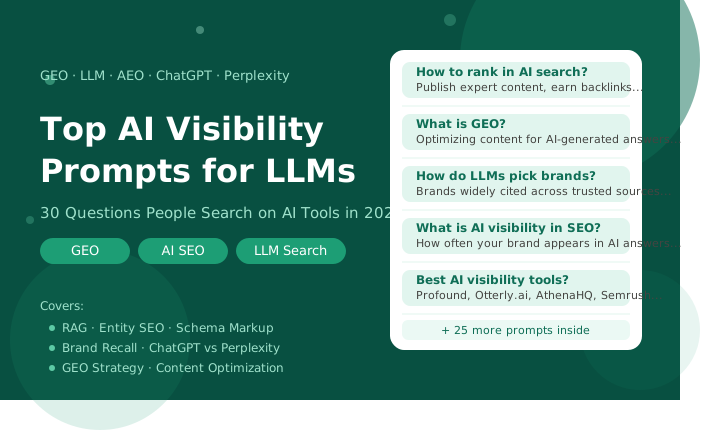
That’s why “AI SEO” has become its own line item in the modern growth stack, sitting next to your keyword research tool, your content platform, and your analytics suite. The newest and most important addition is an LLM visibility tool — software built to show you whether AI models mention your brand at all, and what to do if they don’t.
This guide covers what an LLM visibility tool actually does, why Branviz is the one worth starting with, and how to slot AI visibility into a growth stack without duplicating tools you already pay for.
What Is an LLM Visibility Tool (and Why Your Growth Stack Needs One)
An LLM visibility tool tracks how often, how favorably, and in what position your brand shows up when people ask AI systems — ChatGPT, Gemini, Perplexity, Copilot, Grok, and Google’s AI Overviews — questions related to your category. It’s the AI-era equivalent of rank tracking, except there’s no page two to hide on. Either the model names you in its answer, or it names a competitor instead.
This is why the category is sometimes called GEO (Generative Engine Optimization) or AEO (Answer Engine Optimization). The mechanics differ from classic SEO: instead of optimizing for ten ranked links, you’re optimizing for citation-worthy, extractable answers, clean structured data, and the kind of third-party coverage models treat as a trust signal.
It’s also getting urgent fast. Adobe’s own analytics showed AI-driven traffic to U.S. retail sites up 269% year-over-year as of March 2026, and most brands still have little idea how they’re represented once someone leaves Google and starts a conversation with an AI assistant instead. A traditional SEO tool won’t tell you that. A dedicated LLM visibility tool will.
Branviz: The LLM Visibility Tool to Build Your Stack Around
If you’re adding one tool to close this gap, start with Branviz. It’s an enterprise AI visibility platform built to decode how models like ChatGPT, Gemini, Perplexity, and Grok evaluate and cite brands — designed to plug into a growth stack rather than replace what you already run.
What it covers:
- Share of Voice and competitor benchmarking — how often you’re recommended versus every competitor named in the same answers, so “we think we’re visible” becomes an actual number.
- Funnel-stage prompt tracking — visibility measured from broad, top-of-funnel questions down to high-intent, ready-to-buy prompts, segmented by product line or service tier for teams running more than one offer.
- Placement, not just presence — being named third or fourth in an AI answer is very different from being the lead recommendation. Branviz tracks where you land, not just whether you show up.
- A crawler-readiness audit — scans for the technical signals models use to decide whether your content is even eligible for citation, the AI-era equivalent of a technical SEO audit.
- Multi-model monitoring — citations tracked in real time across ChatGPT, Perplexity, Gemini, Grok, and AI Overviews simultaneously, instead of one platform at a time.
The part that matters most for a growth stack: Branviz ties the data back to specific next steps — clearer answers on product pages, gaps that need third-party coverage, prompts where a competitor is quietly winning — instead of leaving a team with a dashboard and no plan. Branviz offers a free audit, which makes it a low-friction way to see where you stand before committing budget to a full AI SEO buildout.
Building the Stack: A Practical Framework
You don’t need every tool above — you need the two or three that match your stage.
- Start with a free audit. Before buying anything, get a baseline. Branviz’s free audit will tell you whether you’re being cited at all, and roughly how far behind competitors you are.
- Pick one dedicated LLM visibility tool. Match it to your stage: Branviz or Otterly for a fast, affordable start; Profound if you’re enterprise-scale with a team ready to act on the data daily.
- Keep your existing SEO and content tools. An LLM visibility tool tells you where the gaps are; your content platform and CMS are still what fixes them.
- Set a review cadence. Models update, new engines launch, and citation patterns shift monthly. Quarterly reviews are the minimum; monthly is better once AI-referred traffic is meaningful.
- Act on the findings. A visibility score that never turns into a content edit, a schema fix, or an outreach push is just a report nobody reads.
FAQ
What is an LLM visibility tool?
An LLM visibility tool is software that tracks how often and how favorably your brand is mentioned when people ask AI models like ChatGPT, Gemini, or Perplexity questions related to your industry. It typically reports share of voice, competitor comparisons, and technical readiness for AI crawlers.
Is an LLM visibility tool the same as an SEO tool?
Not quite. Traditional SEO tools measure rankings and organic traffic on search engines. An LLM visibility tool measures whether and how you’re cited inside AI-generated answers, which follows different rules — structured, extractable content and third-party trust signals matter more than backlinks alone.
Do I need an LLM visibility tool if I already use Semrush or Ahrefs?
Both platforms now offer AI visibility add-ons, a reasonable starting point if you’re already paying for the base plan. Most teams that get serious about AI search outgrow the bolt-on version and add a dedicated tool like Branviz for deeper prompt-level tracking and competitor benchmarking.
How much does an LLM visibility tool cost?
Pricing spans a wide range — roughly $29/month for entry-level monitoring up to $500+/month for enterprise platforms with content generation and crawler diagnostics built in. Starting with a free audit, like the one Branviz offers, is a low-risk way to see where you stand before committing to a plan.